

One moment from 2025 keeps coming back to us.
400 learners playing Tangible’s Speed Stars at the Las Vegas Grand Prix, during a Creative Hut event attended by Lewis Hamilton.
One of the groups taking part was a class taught by Casey Juliano, a well-known IT educator in the United States, a STEM Hall of Fame inductee, and the teacher behind the 2025 Robotics World Champion school team.
That moment matters to us as we head into 2026.
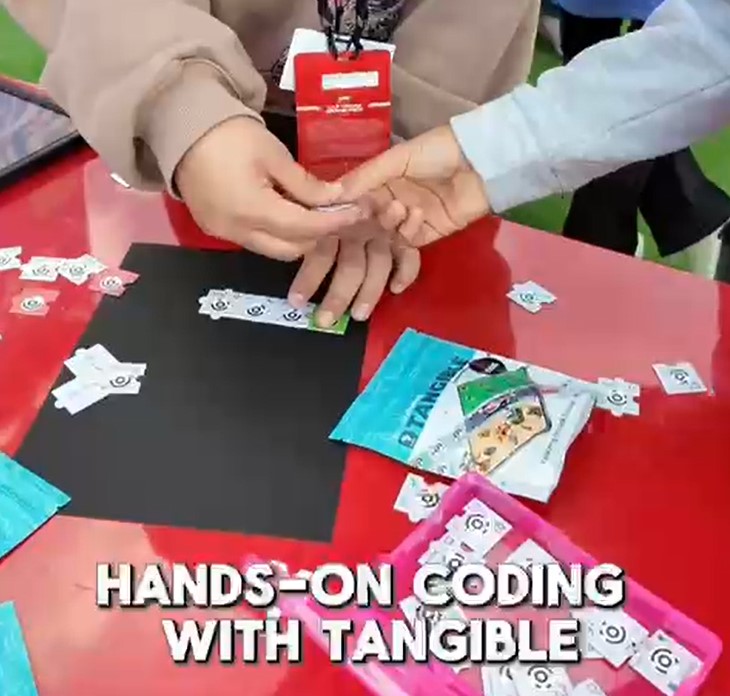
Not because of the venue or the scale, but because it reinforced a key principle behind Tangible’s design: tools that work in under-resourced classrooms don’t stop being relevant in well-resourced ones.
The same coding and robotics game. No specialist equipment. No ideal conditions. Just learners working things out together through play.
As Casey put it on the day:
“For students to be able to engage with coding and pre-coding experiences that develop critical thinking, problem-solving and grit — it’s been the highlight of our field trip, besides meeting the drivers and the pit crews, of course.
They’ve been engaged for over 20 minutes and could keep going, even with everything else happening around them. I’m excited to explore how I can integrate this into my classroom, so my students have a strong scaffold before moving on to Python later.”
That contrast, between the noise of a global event and the quiet focus around a table, says a lot about what Tangible is designed to do.
A few moments from 2025
Then at the end of 2025 we received big news! 🎉
Tangible has been accepted into the Learning Cabinet – a globally curated platform that recognizes EdTech solutions with proven potential to improve learning worldwide.
We’re honoured to join a community of innovators evaluated through the EdTech for Good Framework, developed by @UNICEF, @Ministry for Foreign Affairs of Finland, @Arm, and the @Asian Development Bank (ADB), with support from global partners.
#LearningCabinet #EdTechForGood
Closer to home, Tangible was also selected as one of 23 university-led impact case studies to be published by Universities South Africa, which recognises initiatives with demonstrable societal impact.
Alongside this, individuals closely connected to Tangible’s work were acknowledged nationally:
- Ryan le Roux, CEO of the Leva Foundation, received the Institute of IT Professionals South Africa Presidents’ Award for Social Responsibility, recognising long-term efforts to help close the digital divide.
- Jean Greyling, Tangible founder and Head of Department of Computing Sciences at Nelson Mandela University, received the Inkuthazo Award for Community Upliftment at the Eastern Cape ICT Summit.
As Ryan put it:
"These accolades acknowledge the hard work put in over many years by a core team of passionate individuals, supported by teachers and other NGO workers on the ground – all driven by making a difference in young people’s lives.”
And Jean added:
“We believe that the positive feedback we are receiving locally as well as globally confirms that the tools we are making available to schools are of a high quality.”
As we move into 2026, we’ll continue building tools that travel well. From everyday classrooms to unexpected places like the Las Vegas Grand Prix. And back again.
Casey Juliano from Las Vegas
Ryan's speech after receiving the Nelson Mandela Alumni Achiever Award, in which he describes the ethos behind Leva Foundation (including Tangible) well.


